
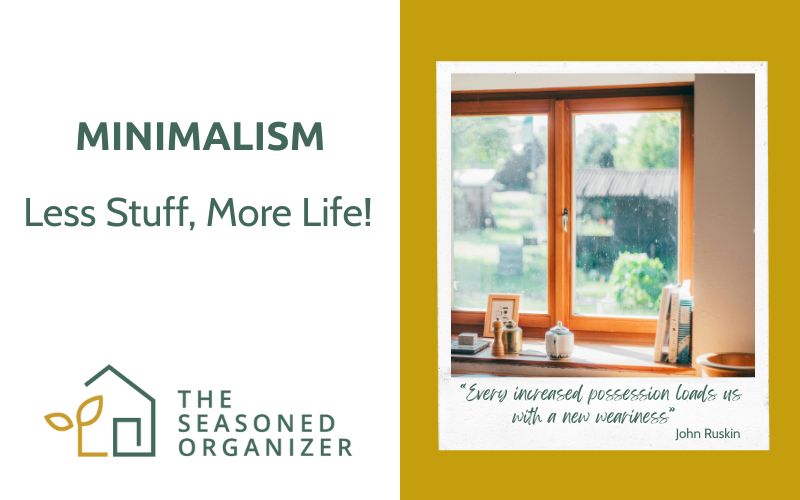
Have you ever asked yourself: Where did all this stuff in my house come from, and why am I still holding on to it?
It’s easy to wake up one day surrounded by things we never meant to accumulate—items we bought for convenience, accepted out of guilt, or kept “just in case.” Over time, our homes begin to reflect decisions made on autopilot rather than with intention. The stuff builds up quietly, layer by layer, until it becomes a blurred background of stress that we barely notice—except when we ask ourselves, Why do I feel so crowded in my own home?
We live in a culture where “more” is the default. More options. More hustle. More storage bins! And somehow, with all that more, we have less. Less time. Less peace. Less space in our home, head, and heart.
It’s no wonder that the message of Minimalism has struck such a chord with so many of us.
“The reason that the message of Minimalism is so powerful is because we’re binging on all the wrong things and we’re dying of hunger for the things that really matter.” — Erwin McManus
Let’s unpack what Minimalism really is—and how it can bring more clarity, joy, and purpose into our everyday lives.

What Is Minimalism?
It’s not about deprivation or one-size-fits-all rules. Some minimalists live in tiny homes. Others live in spacious farmhouses filled with kids, laughter, and baskets of LEGO sets. The goal isn’t to hit a magic number of possessions—it’s to align your life with your values.
In a nutshell, Minimalism is owning only possessions that add value to your life. It favors quality of quantity; function over form. It’s asking “Does this possession support my goals and/or my joy?”
As author and Minimalist Joshua Becker puts it:
“At its core, Minimalism is the intentional promotion of the things we most value and the removal of everything that distracts us from it.”
Why Is It Important?
Minimalism isn’t just about clearing space on your shelves—it’s about clearing space in your life. When we’re no longer spending so much time managing, maintaining, and accumulating stuff, we gain something far more valuable: freedom. Freedom to invest our time, energy, and resources into the people we love, the causes we care about, and the passions that light us up.
A Minimalist mindset is important because it keeps us focused on living a meaningful and fulfilling life. When we begin to strip away the excess, we start to see what truly matters. We create margin. We reclaim time. And we find ourselves living not just with less, but with more purpose.
“We misplace our desire for belonging and satisfaction by buying more stuff.” — Annie Leonard
We often change not by design, but by disaster. But what if we could choose change on purpose? What if we could pursue “less” in order to make space for so much more?

What Does It Look Like in Everyday Life?
Minimalism isn’t about owning as little as possible—it’s about owning just enough to support the life you want. And it isn’t limited to possessions- you can apply it to your relationships, the food you eat, the way you spend your time.
In real life, that might look like:
- Letting go of the “Someday Clothes” in your closet that no longer fit the season you’re in—physically or emotionally—and making space for items that reflect who you are right now.
- Canceling a subscription you don’t use anymore and redirecting those funds toward a weekend getaway, a class you’ve wanted to take, or a donation to a cause you care about.
- Decluttering your digital life by unsubscribing from marketing emails that tempt you to buy things you don’t need.
- Saying No to another back-to-back weekend of obligations so you can say Yes to rest, reading, or simply being home.
- Choosing shared experiences over physical gifts—a family hike, a picnic at the beach, or an afternoon baking cookies with your grandkids.
- Releasing sentimental clutter after taking a photo or writing down the memory—allowing the meaning to stay while the mess goes.
When we strip away the excess, we create room for what actually matters: relationships, health, creativity, generosity.

5 Ways to Introduce Minimalism Into Your Life
You don’t have to overhaul your entire life in one weekend. Start small. Start true. Here are five approachable ways to begin:
- Declutter One Space
Pick one drawer, one shelf, or one surface. Ask: Does this item support the life I want? If not, let it go. - Track Your Time
Just as we declutter our homes, we can declutter our calendars. Notice how you’re spending your days. Where can you trade busy for intentional? - Adopt a “One In, One Out” Rule
For every item you bring in, let one go. It’s a simple way to prevent overwhelm and remain mindful of what truly serves you. - Shift Your Focus to Experiences
Instead of birthday gifts, try giving a day at the park, a museum pass, or a meal together. Memories matter more than things. - Reframe “Enough”
Recognize that abundance isn’t found in accumulation—it’s found in appreciation. The more gratitude we cultivate, the more contentment we experience.
Final Thoughts
Minimalism isn’t about less for the sake of less. It’s about less so that we can experience more:
- Less clutter ➤ More space
- Less stress ➤ More peace
- Less distraction ➤ More focus
- Less maintaining ➤ More creating
- Less buying ➤ More giving
- Less hustle ➤ More flow

Minimalism invites us to live more thoughtfully and intentionally, and to ground ourselves in what truly matters: our relationships, and the joy of living a meaningful life.
Great post and enjoyable newsletter. You always inspire me!
Thank you, Kim! My goal is to provide helpful and meaningful content that is fun to read. I so appreciate you taking the time to comment!