
I think it was Night Gallery’s 1971 story titled “The Escape Route” that initiated my early curiosity of death. (If you’ve not seen it . . . probably for the best.) After watching that story, as a young girl, I used to lie awake at night thinking of the worst possible ways to die.
“Carol, umm . . . really?? Stay with me. It gets better.
I’ll spare you my list, except to say that one method involved creepy, crawly bugs. That’s when I vowed to be cremated upon death, so that I wouldn’t get eaten by them.
It’s funny how early impressions can shape lifelong decisions, especially when it comes to something as final, and as mysterious, as death.
Fast forward to the onset of 2020’s Covid shutdown when, while deathscrolling, I stumbled upon the novel concept of Human Composting.
Perhaps YouTube’s algorithm found my childhood fascination with death. It started with Caitlin Doughty’s captivating videos of her experiences as a Mortician and stories as a Funeral Director. She, in turn, introduced me to Katrina Spade, founder & CEO of Recompose, the company that engineered a new form of deathcare called Human Composting. (Links to these Deathcare advocates are below.)
And just like that, something shifted. What once felt scary began to feel . . . surprisingly uplifting.
What Exactly is Human Composting?
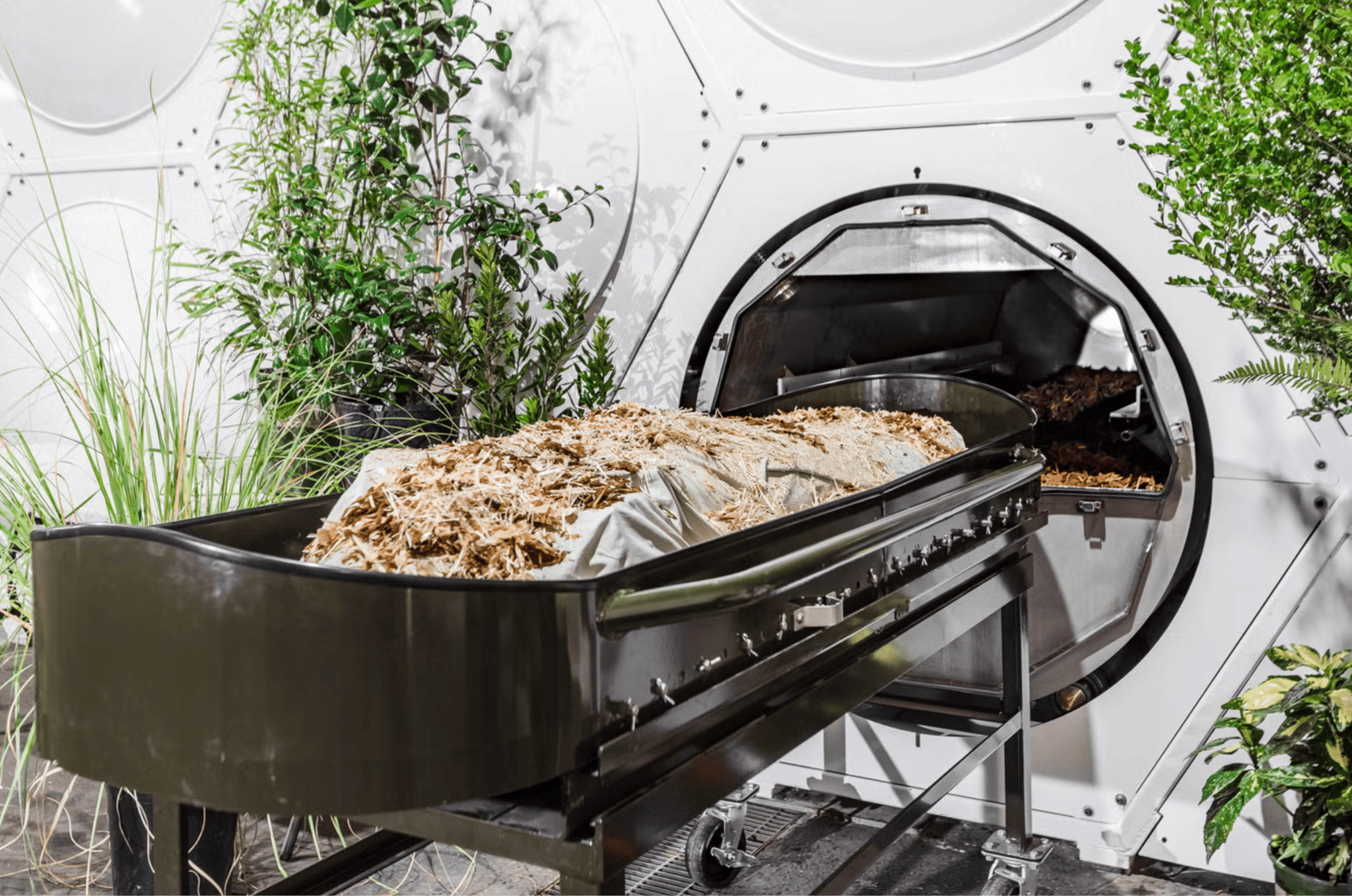
Photo credit: Recompense Media and BRoll Images
Human Composting, also known as Natural Organic Reduction, is a carefully guided, respectful process that transforms the body into nutrient-rich soil.
It sounds outlandish at first, but when you look closely, it mirrors what nature has done beautifully since the beginning of time.
The body is placed in a vessel with organic materials like wood chips, alfalfa, and straw. Over the course of about 30–60 days, naturally occurring microbes break everything down, converting the body into soil. The process is carefully monitored for temperature, airflow, and moisture to ensure it is both safe and complete.
At the end, what remains is approximately one cubic yard of clean, fertile soil- enough to fill the bed of a pickup truck. Families can keep the soil, scatter it, or, like we chose, donate it to conservation efforts that restore forests and natural habitats.
There is no rush, no harsh chemicals, no fire. Just a return to the earth in its most life-giving form.
The Contrast of Traditional Practices
For generations, burial and cremation have been the standard.
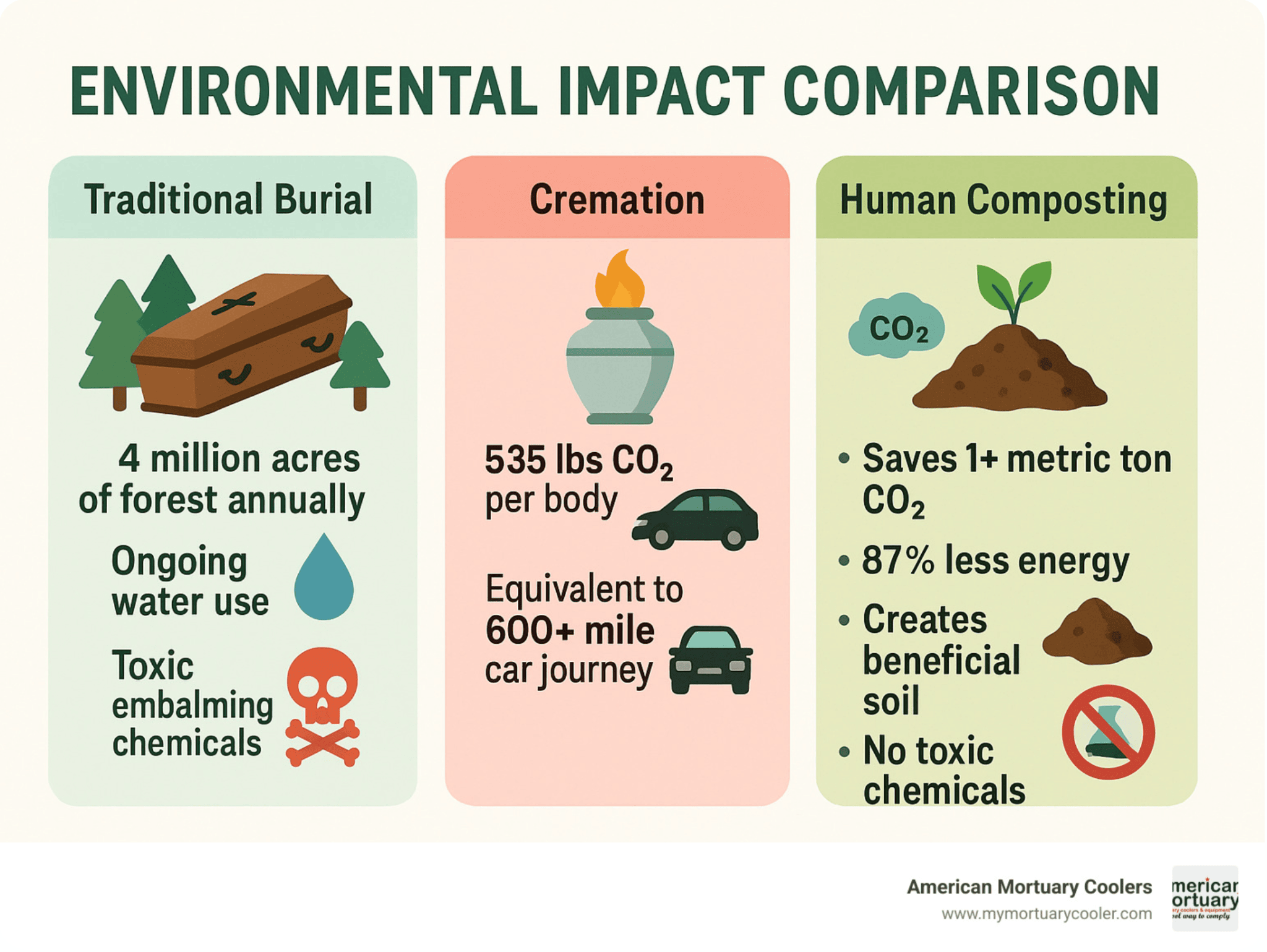
But upon further research, I found that these practices come with significant environmental and financial costs. Traditional burial uses vast resources: hardwood for caskets, steel for vaults, and toxic embalming fluids that can seep into the soil. Cemeteries require ongoing land use and maintenance, often in perpetuity.
Cremation, while often seen as simpler, still carries a hidden environmental toll. Each cremation requires a substantial amount of energy and releases emissions into the air, including carbon dioxide and trace pollutants.
In other words, what we’ve long considered “normal” just isn’t sustainable.
Human Composting offers a different path- one that reduces environmental impact while allowing us to give back to the earth.
A Growing Movement Rooted in Meaning
Human Composting is gaining momentum across the United States, driven by people who want their final act to reflect their values: simplicity, stewardship, and sanctity of life in death.
As of now, it is legal in several states, including Washington, Oregon, California, Colorado, Vermont, New York, Nevada, Arizona, and a growing list of others as legislation continues to evolve.
The transformation into dense, nutrient-rich, life-giving soil allows us to participate in the Circle of Life.
I was intrigued with the principle: minimizing the harsh byproducts of traditional burial while replacing it with the simplicity of nature’s efficiency.
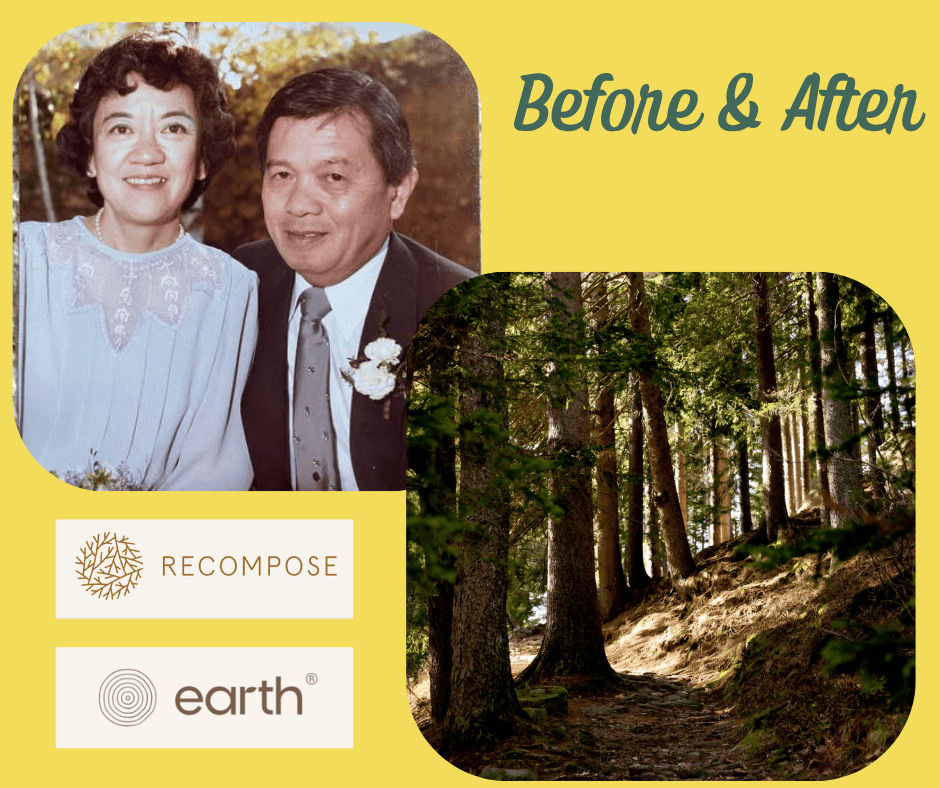
When George (my stepdad) died, Mike (my brother), and I decided to honor him by turning him into soil. Mom already had significant mental decline, but she understood what would happen, and was in full agreement. I asked her, “Would you also like to be turned into soil when you die?”
“Why, sure!” she exclaimed. What a relief!
Rather than fear or uncertainty, Mom trusted our intention. This woman who taught us to grow a Victory Garden in our childhood backyard fully embraced the invitation to “return to my roots”, as she used to say. What a gift!
Neither Mike nor I had the space for the cubic yard of soil produced by each parent. George died in Oregon, and is now on the Olympic Peninsula, reforesting a historically logged parcel of land.
Mom died here in San Diego on October 4, 2025. We sent her to Earth Funeral’s facility in Arizona, where she is now restoring and protecting a native ecosystem nearby.
Even now, it brings me comfort to imagine them nurturing our planet, being absorbed into something much larger than themselves.
From Fear to Peace
As a young girl, I feared what would happen to my body after death- especially the idea of being consumed by bugs. It felt frightening and agonizing- something to avoid at all costs.
And yet now, I find myself more than “at peace”- I’m excited to know that when I die, my physical body will still have value and utility as it nurtures our planet.
This is my plan for when I die, and I’ve already discussed it with my family. It’s also included in my Last Will & Testament so that there will be no questions of what to do with my body when my life on earth expires.
Human Composting isn’t just “dust to dust”. It allows us to give back to the earth, to restore what’s been depleted. We get to continue to give life. What a beautiful and meaningful legacy!
A Thought to Carry With You
If you’ve never considered alternatives to traditional burial or cremation, you’re not alone. Sometimes, a small shift in perspective opens the door to something unexpectedly hopeful.
If this topic resonates with you, or if you’d like help navigating next steps for yourself or a loved one, I would be honored to talk with you and share some resources.
Featured Resources & Further Exploration
If this topic sparked your curiosity, here are a few trusted voices and resources to explore at your own pace:
A clear, visual introduction to how the process works and what makes it so unique.
Caitlin Doughty – Ask a Mortician
Engaging, thoughtful videos that explore deathcare with honesty, education, and a touch of humor.
Learn more about the pioneering organization behind Human Composting and their mission to transform deathcare.
Environmental Impact of Traditional Burial & Cremation
A well-researched overview of the environmental costs associated with conventional practices.
A service provider offering Human Composting, including options for conservation-based soil return.