
Letting Go Without Losing the Story
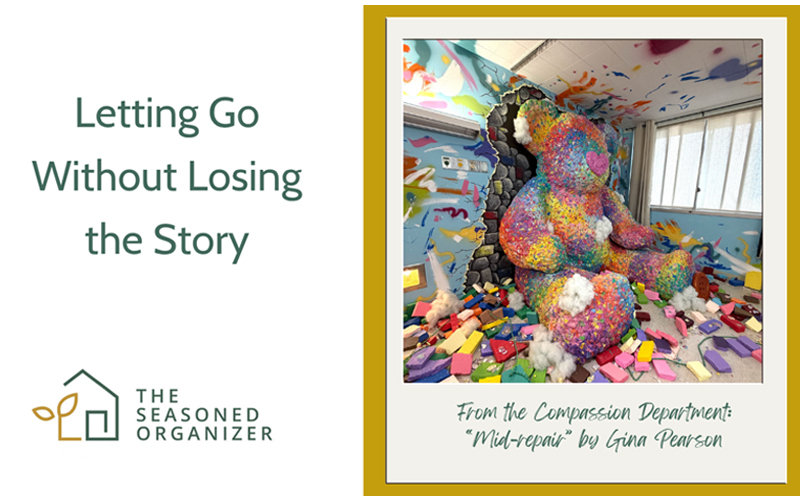
In September, my friend, Trina, and I visited the Hospital of Emotions in Los Angeles. Housed in the now-closed St. Vincent Medical Center, more than 70 artists transformed over 80 patient rooms, nurses’ stations, and other hospital spaces into artistic interpretations of human emotion. Visitors move through four floors of “departments” devoted to emotions such as joy, love, anger, sadness, hope, gratitude, compassion, and resilience.
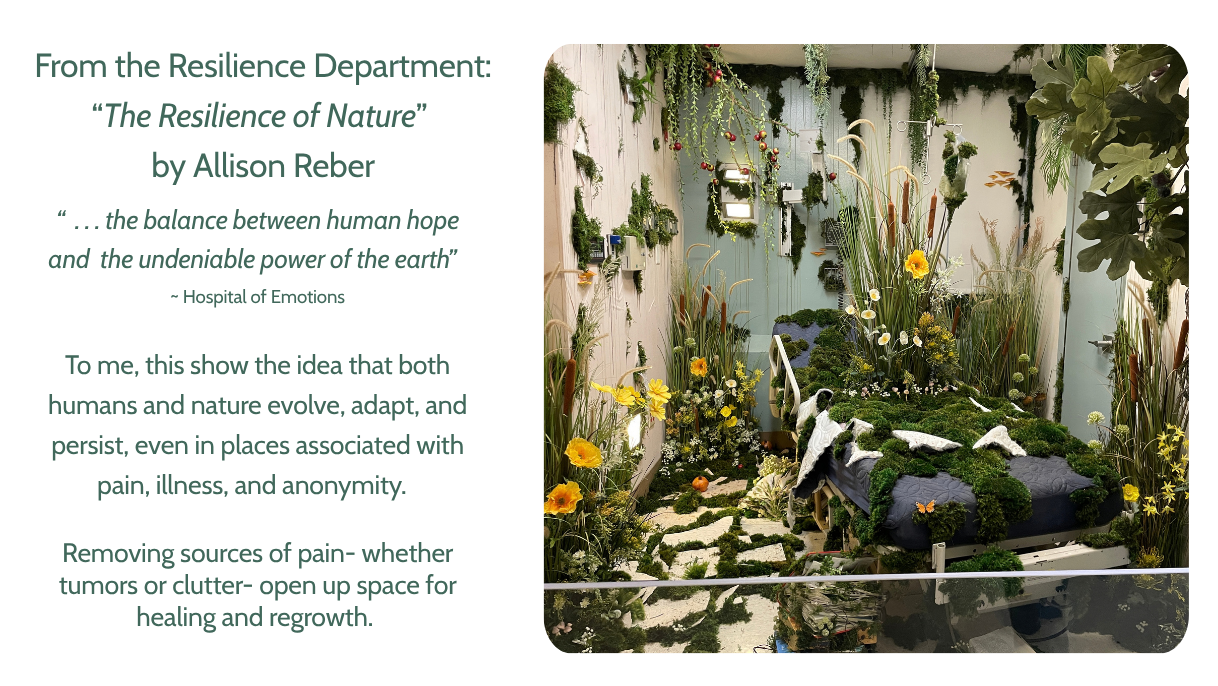
Unlike a museum, where you simply look at the art, visitors walk into each display of emotion. Each installation has a placard that articulates the artist’s vision for the space. Some rooms are playful and exuberant; others explore grief, trauma, or human connection. Each space invites you to slow down to understand the personal stories behind the installations. Together, the artists turned an abandoned hospital, a place ordinarily associated with treating the body, into a place for examining what happens in the heart.
What struck me is how the range of emotions in this exhibit is also present in the decluttering process of organizing a home. Both hospital patients and people parsing through a lifetime of artifacts experience Fear, Sadness, and Anger. Along the way, these feelings can be tempered with Resilience, Gratitude, and Hope.
At first glance, a hospital and a home could hardly feel more different.
Hospital: An unfamiliar, sterile place we go when we are sick, uncertain, and vulnerable.
Home: A familiar, comforting place where we belong and expect to feel safe.
Yet both can become places of profound vulnerability.
The Stories Our Things Carry
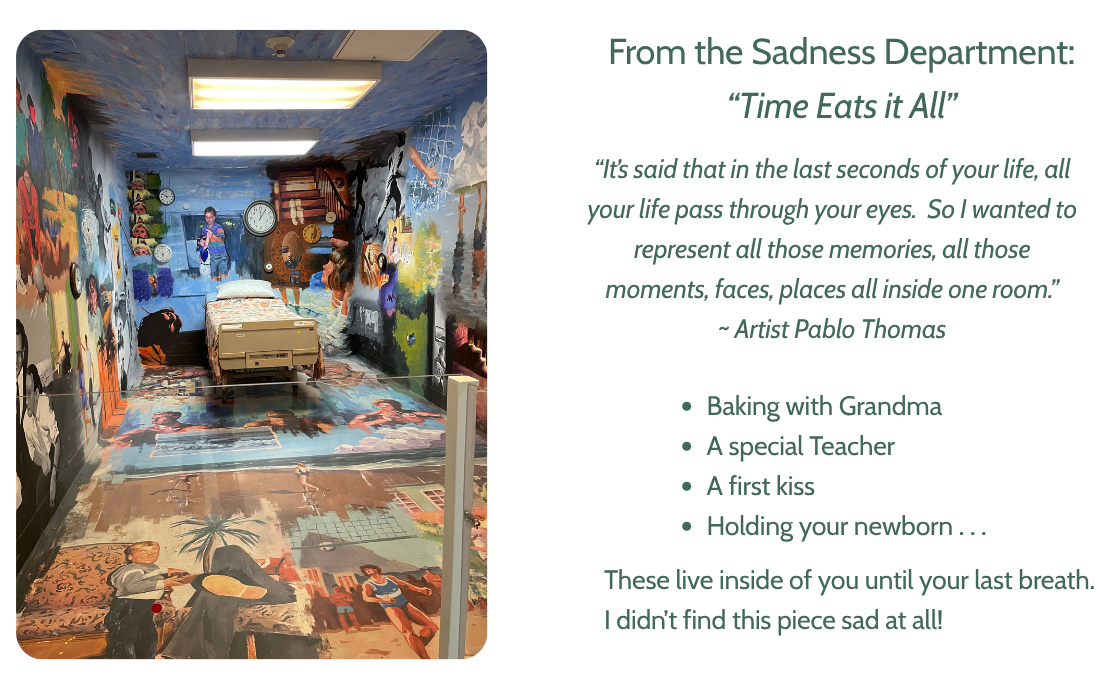
In a hospital, circumstances may force us to confront loss we never chose. Decluttering is certainly less dramatic, but sorting through the possessions of a lifetime can expose losses of another kind: the people, identities, dreams, and Seasons of Life attached to the things we own.
But if we allow it, each experience gives us an opportunity to acknowledge, process, and eventually make peace with emotions that often remain unspoken.
In the Hospital, we might have to say Goodbye to a person we love, a lifestyle no longer possible, or expectations for how we thought life would unfold. Diagnoses, doubts, and death can bring genuine grief.
In our homes, Goodbye may look different. Perhaps it is the china that belonged to Mom, the golf clubs we can no longer comfortably use, clothes from a career we’ve left behind, or supplies for a hobby we once adored. The object may seem irrelevant to someone else. But it feels like a piece of our heart to us.
Whether by force or by intentional choice, letting go of something once beloved arouses a wide range of emotions, many of which can feel deeply uncomfortable or unsettling.
The good news is that the life lessons, feelings, and memories attached to the person, achievement, or dream live on inside you. They have shaped the person you are today- your perspective, behaviors, and values. Trust your heart to keep them there.
What Are You Afraid of?
A powerful part of working through any emotion is simply being willing to name it. Rather than immediately trying to make it disappear, acknowledge what you’re feeling. Sit with it for a moment. Explore where it comes from and how it affects you.
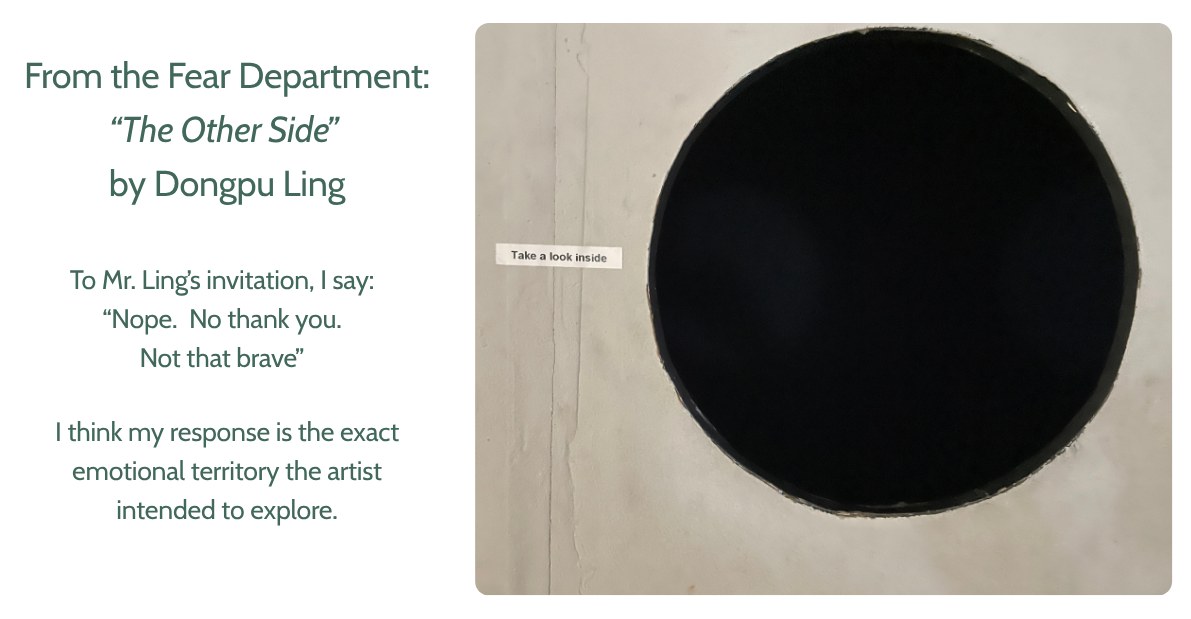
For example, in the Fear Department, artist Dongpu Ling’s installation, The Other Side, explores our profound fear of the unknown. On one wall was a literal Black Hole, about the size of a laundry basket, its interior painted that ominous shade of black that seems to swallow even the slightest hint of light. Next to it was a simple invitation: “Take a look inside.”
Now, logically, I knew this art exhibit was safe for public consumption. There was no rational reason to believe that anything inside that hole was going to harm me. There certainly wasn’t a guillotine poised to slice off my nose the moment I stuck my face inside.
Yet Trina and I giggled nervously as we backed away from looking inside. This seemingly safe prompt was too unnerving for us to examine.
We never found out what was inside that Black Hole. And while we missed out on that opportunity for growing inner strength, we did talk about our unfounded fears. It was fear of the unknown that kept us from discovery.
Name it & Claim it
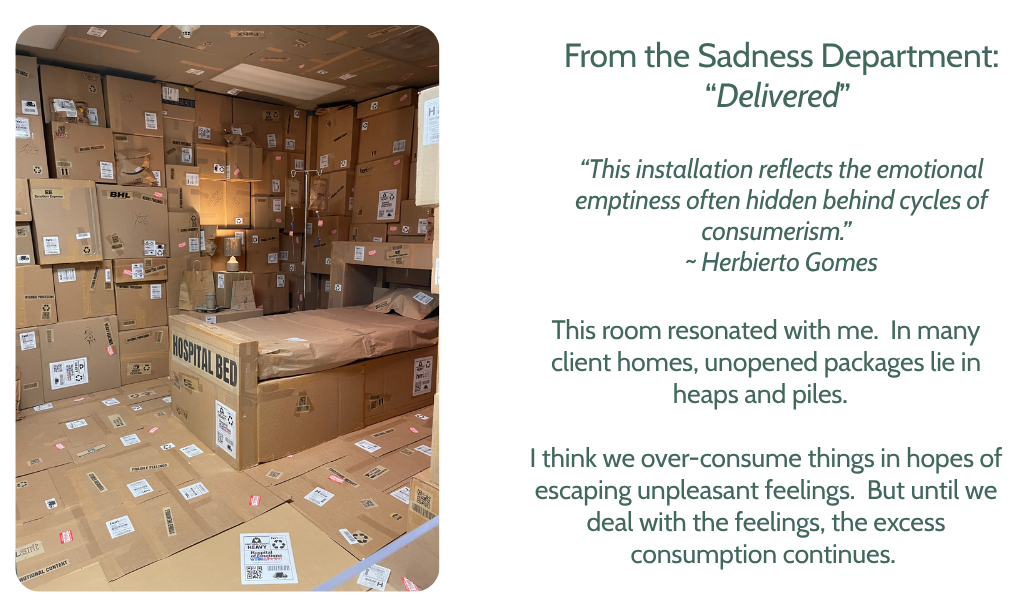
And isn’t that often how fear works? What we imagine might happen can feel more threatening than what is actually there.
That’s the whole point of the Hospital of Emotions. Vulnerability is creatively, wildly, on display, providing a safe space to parse out those complicated feelings. Acknowledge and sit with them, exploring where they come from and what they mean to you.
And that’s what decluttering can do as well. It’s a space to reflect on what the object means to you, and why that is so. Once you uncover and label the emotional attachment, you can move on to Gratitude and Hope. Gratitude for the internal gifts that the object represents, and Hope for the way those gifts are reflected and expressed in the person you’ve become.
Letting go doesn’t mean that you’re losing the story. It means recognizing that the most important part of that story lives on inside you, not in the object.
“The presence of sadness [or any emotion] becomes a testament to what we value: what we attach to and where we find meaning. To feel sadness is to know what we hold dear.” ~ Kim Farbota, Artist
Your Turn
Is there an item in your home that your head tells you to release, but your heart tells you to hold tight? An ignored tea cup collection? A buried concert T-shirt? Rather than closing the cupboard or dresser drawer where they live, hold them. Sit quietly with the item.
Remember where it came from: what was that specific Season of Life like? Who was around? How did it make you feel?
How do you feel about the item now? Not what it represents, but the material, physical item that you hold in your hands. Notice how your body feels.
Do you feel a heaviness? Are your shoulders slumped? Is there a tightness in your gut? That may be your body telling you that it’s time to release the item.
Or, is there a genuine KonMari Spark that lifts your chin and straightens your spine? That’s your body telling you that this piece still belongs with you. Keep it.
There is no prize for letting go of something before you’re ready. Nor is there virtue in keeping an object only because it once mattered. The goal is to understand what you’re feeling well enough to make an intentional choice.
It can be really hard to do this by yourself. Consider asking a friend to join you in this experiment. Having someone with you can give you the strength to press in, acknowledge, and express your feelings. Human connection is a beautiful gift to share!
GO See it For Yourself
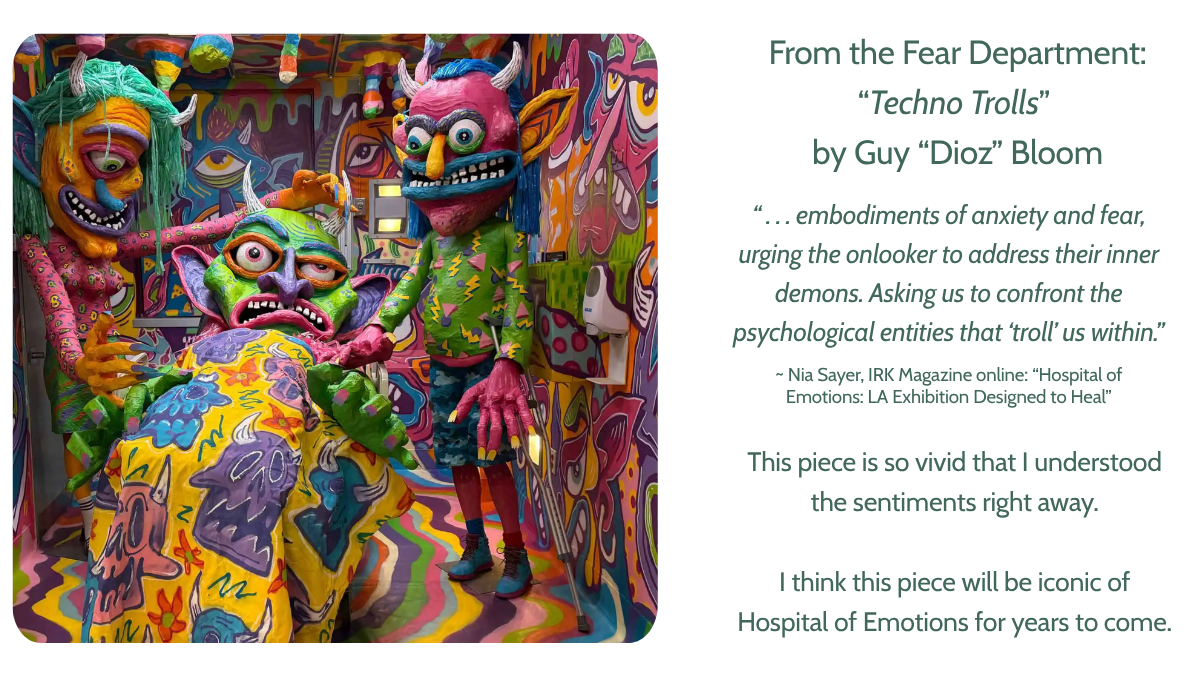
If you can, visit the Hospital of Emotions. Yes, you can see pictures online, but it will resonate more deeply in person. The exhibit continues through January 2, 2027.
There is something especially fitting about what will happen to the building after the art comes down.
St. Vincent was founded by the Daughters of Charity in 1856 as Los Angeles’ first hospital. After the medical center closed following bankruptcy in 2020, this historic campus entered another Season of Life.
Its next iteration will be the St. Vincent Behavioral Health Campus: a large behavioral-health, recovery, and supportive-housing community serving people experiencing homelessness, mental illness, and addiction. Plans include mental-health and addiction treatment, recuperative care, interim and permanent supportive housing, and more than 800 beds.
So even the Hospital of Emotions itself is practicing a form of letting go: honoring what came before while making room for what comes next.
Images featured in this Blog are from Hospital of Emotions and related promotional sources.